

 Economic Contribution
Our contribution to society extends beyond delivering enjoyment to consumers. It encompasses economic value creation, employment generation and meaningful community engagement across Malaysia and Singapore.
Through our operations and broader value chain, we contribute to national economies by sustaining jobs, supporting industry partners and generating tax revenues. Our activities align with the United Nations Sustainable Development Goals (UN SDGs), particularly Goal 8 on sustained, inclusive economic growth and productive employment.
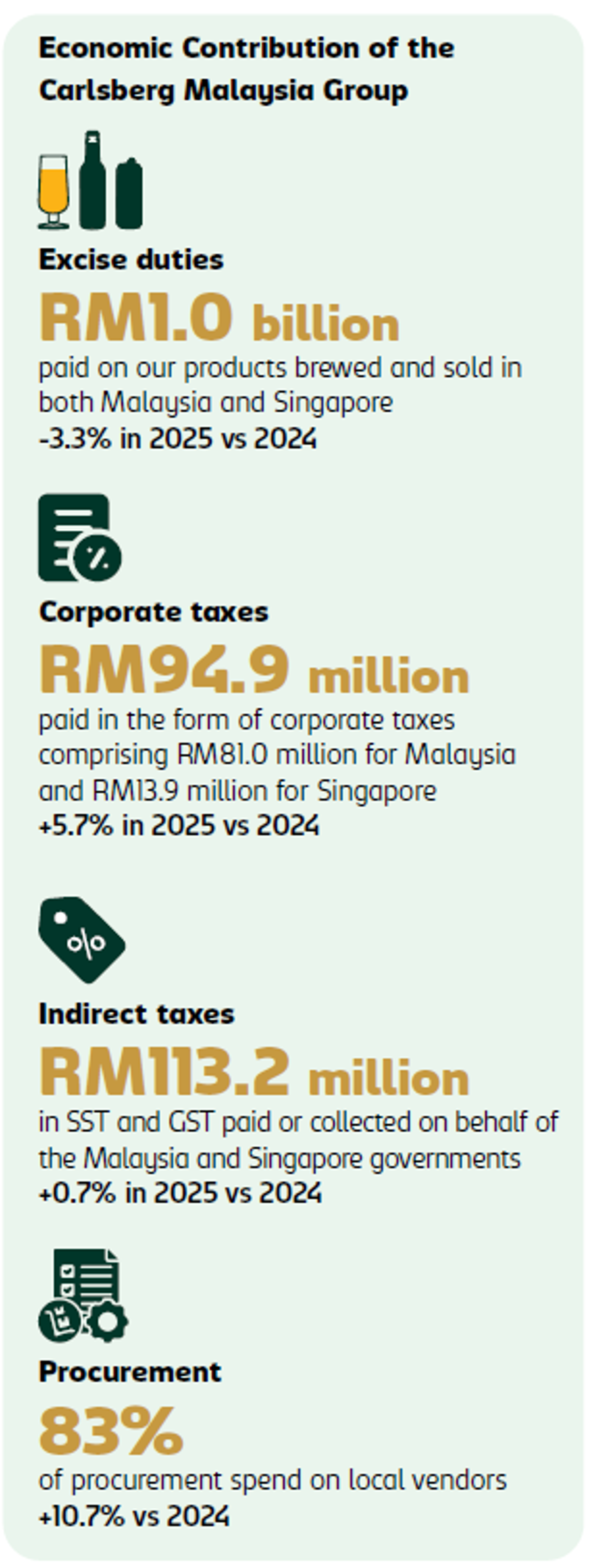
In 2025, our operations contributed RM1.2 billion in excise duties and taxes across Malaysia and Singapore, while directly employing 878 individuals across both markets.
Beyond our direct economic footprint, we continued to engage local enterprises and community partners. This included sourcing from small and medium-sized enterprises and collaborating with festival organisers, non- overnmental organisations and other stakeholders to promote responsible enjoyment and community well-being.
 8.1, 8.7 & 8.8
Economic Contribution of Malaysia’s Brewing Sector
In 2025, the Confederation of Malaysian Brewers Berhad (CMBB), representing Carlsberg Malaysia and Heineken Malaysia, commissioned an independent Economic Contribution Study to assess the industry’s footprint across Malaysia. The study evaluated the sector’s direct operations and its wider value chain impact, covering economic, fiscal, employment, social and environmental dimensions. In summary, the study clearly illustrates the sector’s contributions to the domestic economy, public finances and employment, with multiplier effects extending across upstream suppliers and downstream trade.
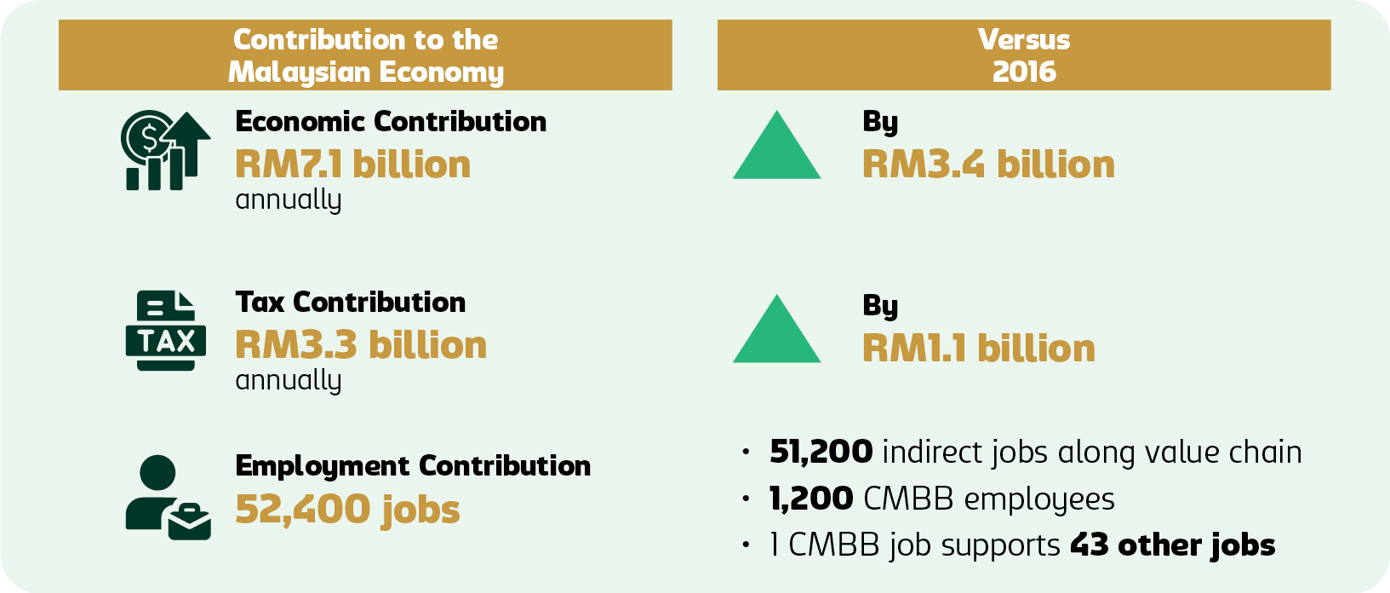
Based on statistics for the years 2022 and 2023, the study estimated that the local brewing sector contributed RM7.1 billion annually in value added to Malaysia’s economy, equivalent to approximately 0.4% of national Gross Domestic Product. Of this, RM3.6 billion arose from direct operations of the two brewers, while RM3.5 billion was generated through upstream suppliers and downstream trade partners, including retail and hospitality. On a per litre basis, the economic value-added rose from RM13 in 2016 to RM23, reflecting higher production volumes and deeper integration with domestic supply chains.
In addition, contributions to government revenue remain significant. The study estimated average annual tax contributions of RM3.3 billion from 2022 to 2023, representing approximately 1.5% of total national tax revenue. Total tax contribution rose by 65%, from RM2 billion to RM3.3 billion compared to 2016, due to greater economic activity and higher tax yields across the value chain. On a per litre basis, each litre of beer produced and sold generated RM10.60 in direct and indirect tax revenue. The sector also supported approximately 52,400 jobs nationwide, of which about 1,200 were direct brewery employees. Each direct job supported an estimated 43 additional jobs across the broader economy.
Beyond core economic metrics, the study highlighted the industry’s integration with local businesses and communities. For example, approximately 80% of procurement expenditure was directed to Malaysian-based companies from 2022 to 2023, reinforcing linkages with domestic manufacturing and services sectors. The study also documented ongoing environmental and social initiatives undertaken by both brewers, including emissions management, water stewardship, recycling programmes, responsible consumption campaigns and community fundraising initiatives.
DID YOU KNOW?
Central & Eastern Europe and India
-
Azerbaijan
-
Belarus
-
Bulgaria
-
Canada
-
Croatia
-
Estonia
-
Greece
-
Hungary
-
India
-
Italy
-
Kazakhstan
-
Latvia
-
Lithuania
-
Nepal
-
Serbia
-
Ukraine