
Materiality Review
Material matters represent the sustainability-related topics that are most relevant to the Group’s business, operations and stakeholders. These matters inform how we prioritise and manage sustainability-related risks and opportunities within our strategy, operations and risk management processes.
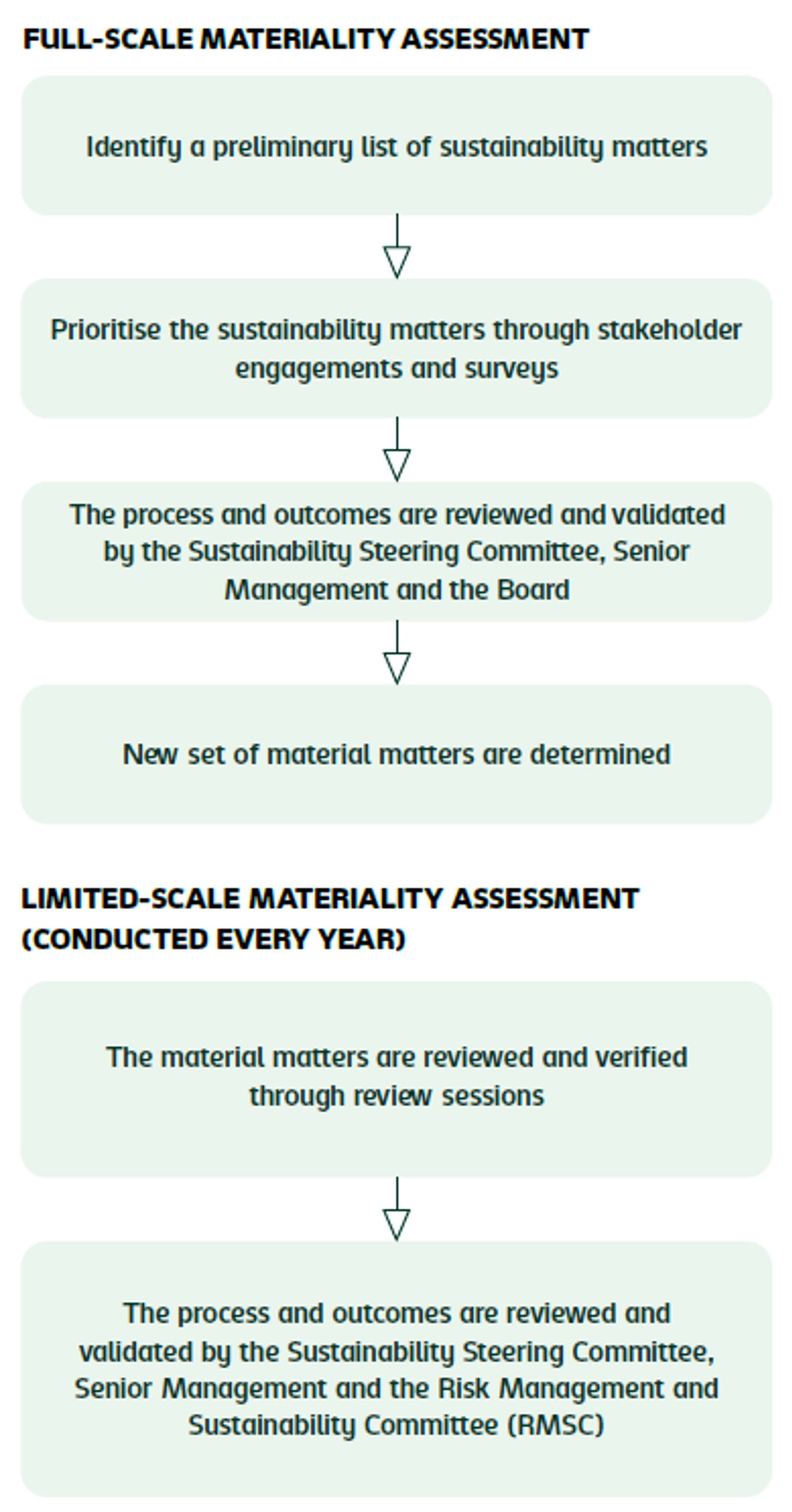
This 2025 review builds on prior materiality work, including a consultant-led full-scale materiality assessment conducted in 2022, a materiality validation exercise in 2023 and a limited-scale materiality assessment in 2024 and 2025 that narrowed the Carlsberg Malaysia Group’s priority material matters to 13 and 10 respectively
The review was aligned with the Group’s regular risk management processes and informed the prioritisation and relevance of material information for sustainability reporting under the IFRS Sustainability Disclosure Standards of the International Sustainability Standards Board (ISSB). The materiality review was performed by the executive-level Sustainability Steering Committee (SSC) (refer to page 79), with input from sustainability functional owners across the Group. The outcome of the process was presented by the Chief Sustainability Officer and tabled for approval by the Board of Directors.
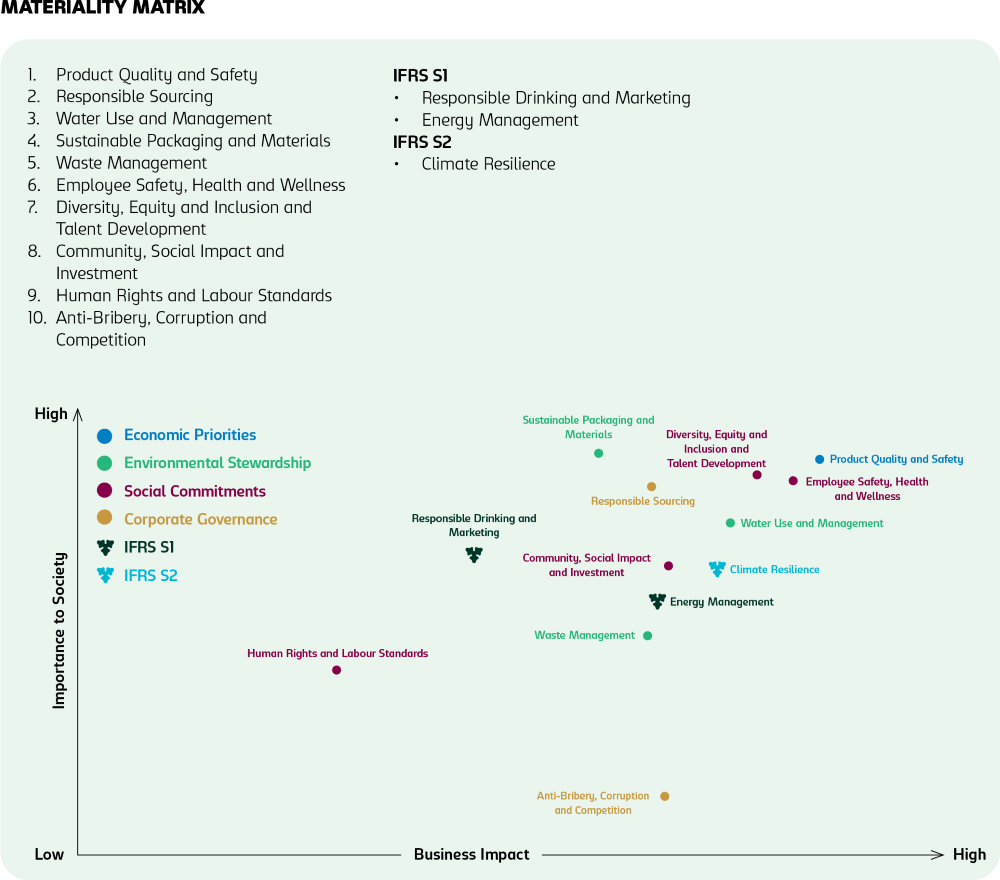
Following this review, 10 material matters were prioritised for reporting, reflecting those assessed to have the most direct relevance to enterprise value and stakeholder decision-making.
In applying ISSB IFRS S1 and IFRS S2, the Group determined
that Responsible Drinking and Marketing and Energy Management represent the most significant sustainability related matters. As such, Responsible Drinking and Marketing is disclosed under IFRS S1, consolidating topics previously reported as Responsible Advertising and Marketing and Preventing Harmful Use of Alcohol. Energy Management is also reported under IFRS S1 and features disclosures previously covered under Energy and Carbon.
Climate-related topics are addressed collectively under IFRS S2: Climate Reporting including disclosures under Climate Resilience, with a focus on the increase in rainfall intensity. Waste Management is reported as a standalone material matter within the Sustainability Statement while Anti-Bribery, Corruption and Competition continues to be addressed under Corporate Governance. Refer to pages 72 to 124 for the Sustainability Statement and page 79 for the Carlsberg Malaysia Group materiality matrix for 2025. Remaining material matters are disclosed across the Sustainability Statement, Management Discussion and Analysis and relevant governance sections, aligned with their relevance to value creation and the risks and opportunities consideration.
OVERALL SUSTAINABILITY GOVERNANCE
The Board of Directors (“Board”) has overall responsibility for overseeing sustainability and climate-related matters material to Carlsberg Malaysia Group’s business, strategy and stakeholders. The Board ensures compliance with regulatory requirements, maintains high standards of corporate governance and safeguards long-term shareholder value.
In fulfilling its fiduciary duties, the Board oversees strategic direction, internal controls, risk management, sustainable
business practices and succession planning. Sustainability and climate-related considerations are integrated into deliberations
on strategy, capital allocation and risk, ensuring informed decision-making at the highest level of governance. Management is accountable for execution, with sustainability and climate-related responsibilities embedded across the governance framework. Performance objectives and remuneration are aligned with defined sustainability and climate-related key performance indicators, reinforcing accountability across operations and long-term planning.
The Board recognises that the transition to a low-carbon economy involves complexity, trade-offs and phased implementation. As such, we have developed strategies across the short-, medium- and long-term transition horizons, as defined under the Strategy section for IFRS S1 and S2 respectively on pages 81, 85 and 86.

Central & Eastern Europe and India
-
Azerbaijan
-
Belarus
-
Bulgaria
-
Canada
-
Croatia
-
Estonia
-
Greece
-
Hungary
-
India
-
Italy
-
Kazakhstan
-
Latvia
-
Lithuania
-
Serbia
-
Ukraine